




We’ve been expecting you
“I hear, but I don’t listen”
– Wim Duisenberg (1935-2005), First President of the ECB
There are times when stock markets refuse to listen to bond markets, or so it seems. For a few years now, two investment narratives have been in place; the AI-driven boom, benefiting inter alia the ‘picks and shovels’ of information technology hardware, a notoriously cyclical sector. The other has been rising bond yields, driven by stubborn and sticky inflation. Inflation has been driven by several factors including two wars, which are ongoing, and partial de-globalisation thanks to a shift towards a multi-polar world. Tariffs, retaliation, and onshoring seem to be the new world order. The first narrative, a bull market in a very narrow part of the stock market, has been harder to play for those who seek to manage risk via diversification, in the knowledge that investment booms always, ultimately, end in busts. The bear market in bonds, which began during the depths of Covid, in the summer of 2020, has perhaps been somewhat easier to read, at least for those with long memories and an eye on financial history.
The shape of the AI investment boom is evolving rapidly, to which the volatility in relevant share prices since the summer attests. Critically, it is evolving into a financing story as well as a technology story. Projected capital expenditure at the six largest US hyperscalers is expected to exceed their operating cash flows in both 2026 and 2027. Despite some of these companies being among the most profitable on earth, they are also issuing record amounts of debt (see Figure 1). Further down the chain, dependence on financing is more acute: AI cloud provider CoreWeave has approximately $50bn of debt, with some of its bonds recently yielding close to 16%, an unambiguously distressed level.
Figure 1: US Hyperscaler bond issuance ($bn)
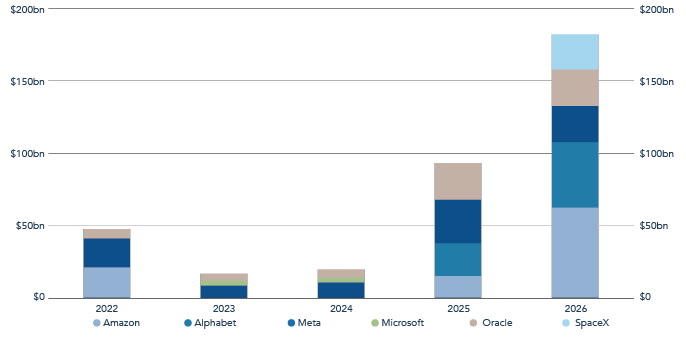
Source: Bloomberg, 30 September 2026. Past performance is not a guide to future performance. The reference to specific securities is not intended as a recommendation to purchase or sell any investment.
The question today is whether these two narratives can continue to co-exist, or whether rising bond yields will call time on a boom that is progressively more exposed to the price of money? For now, it seems stock markets can ignore their clinically dispassionate fixed income peer. They may hear, but are they listening?
Duration Kills
By 2021, it was becoming clear that the long bull market of rising prices in bonds, and ever-falling yields, which began in 1981, was over. In 2026, the surprise to many has been the rising march of bond yields and more recently interest rates, as central banks have been proven to be behind the curve, and complacent on the inflation outlook. In the case of the US, inflation has remained above target for 66 months in a row. Despite a modest fall in bond yields in recent weeks, the 10-year benchmark yields have risen by ~1% this year, to 5.1% in US Treasuries and 5.4% for the equivalent UK government bonds (gilts). These are levels not seen since before the Great Financial Crisis (GFC), almost 20 years ago. In the UK, longer-dated 30-year yields reached almost 6%, a level not seen since 1997. It is worth saying, there is nothing abnormal about such levels. It was the period from 2010-2021 that was the aberration.
From a fixed income perspective, we have shunned conventional bonds of any material duration, in preference for shorter-dated index-linked bonds providing much-needed inflation protection. In the meantime, gold has been retained as a helpful portfolio diversifier. These views have been expressed in our Multi Asset strategy for years and have generally been correct, even if this was about avoiding losses more than making positive returns in years like 2022 and again during this year, as yields rose sharply and bond prices fell. Bear markets are not linear and are never easy to time, so we have chosen not to ‘trade’. This might seem unimaginative to some, but our mandate is to ‘protect first’.
Looking at longer-duration gilts, since yields troughed the damage to capital has been dramatic. The 2071, 1.625% coupon conventional gilt peaked at a price of £160 in May 2020 and today trades at £36, a capital loss of over 75%. The low coupons which became common in the 2010-2021 period made the bonds even riskier – minimal income means most of the value in these bonds lies in the capital returned at maturity, increasing duration and making their prices especially vulnerable to rising yields. That duration has destroyed capital value, and the >75% figure above is in nominal terms, in a period when inflation has risen over 30%. Long-dated bonds can once again be described as ‘certificates of confiscation’, as they were in the 1970s.
After this much value destruction, are bonds now a bargain? Our answer would be yes, and no. With yields at ~5%+ the prospect of losses looks materially lower, at least in nominal terms. Yet bond bear markets can last for decades, not years. There remain good reasons to be circumspect about taking too much duration risk for anything more than a counter-trend rally.
In recent months we have tweaked the duration for our index-linked holdings up to 3.3 years. With real yields up to 3%, these are attractive levels by any historical basis. Nevertheless, nominal yields may yet go higher. The policy rate required to get inflation back on track may be higher than policy makers expected. As Gerard Minack reminds us, “the average G7 policy rate never exceeded inflation in the 14 years after the GFC. But in the 18 years before the GFC the policy rate was never below inflation. Returning to a pre-GFC norm will require higher real cycle-average policy rates, which points to higher long [duration bond] rates.” Back in 2010, zero interest rates were referred to as the “New Normal”. We have now returned to the old normal.
Bond Villains
There are plenty of reasons to remain cautious on conventional bonds. The most obvious is inflation. While the future oil price is unknowable, predicated as it is on the outcome of two wars (or even three, if you throw in Saudi Arabia and the Houthis), food prices look highly likely to accelerate into 2027. These pressures are yet to be fully reflected in the current CPI figures. In the past quarter we met with Chris Elliott, founder of the Institute for Global Food Security at Queen’s University Belfast. He reminded us that we are no longer looking at what climate change will do in the future, but rather what it is doing now. Super El Niño combined with disruption in the Strait of Hormuz risks adding further inflationary pressure. Elliott believes, “the collision of natural and man-made events represents one of the most serious threats to global food security in living memory- with likely devastating consequences reverberating across harvest cycles for between three to five years.”[1]
Issuance of government debt and rising interest costs are the other main factors to consider. In July the United States national debt exceeded $40tn. Such debts were manageable at near-zero interest rates but at 5%+ the interest bill is ratcheting up as the debt grows. Moreover, the share of foreign ownership of US Treasuries has declined in the past decade. China has not added to its holdings since 2013, while others are also less inclined to support America’s exorbitant privilege. An increasing share of new issuance must instead be absorbed by more price-sensitive investors. Hedge funds have helpfully filled part of the gap, now holding 9% of US Treasuries (see Figure 2), but these owners are unlikely to be as reliable as foreign central banks’ reserves, such as those of Japan – the largest overseas owner.
Figure 2: Percentage of US Treasuries held by hedge funds
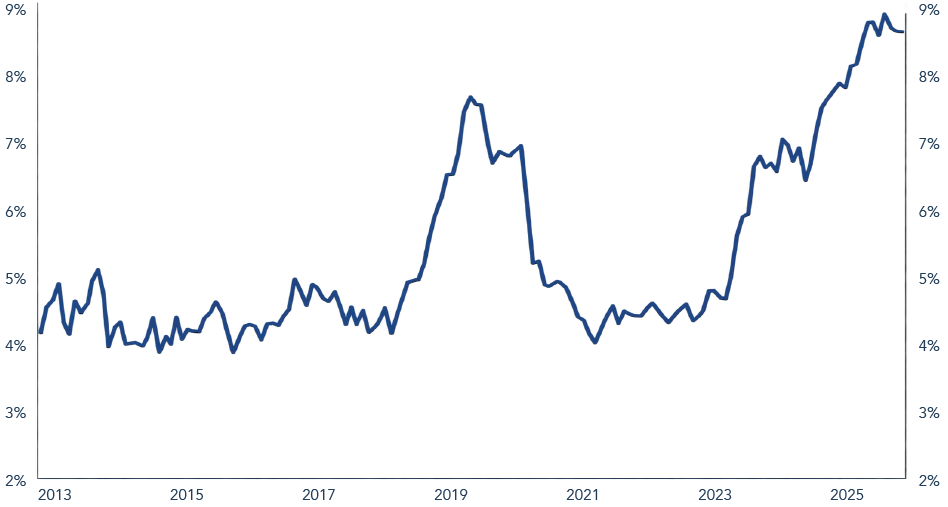
Source: Federal Reserve, 31 August 2026.
Scott Bessent, US Treasury Secretary, an erstwhile hedge fund manager, is aware of the weaknesses in the debt chain. He is attempting to walk the tightrope to avoid a further spike in bond yields. His recent intervention in the foreign exchange market to support the yen was revealing. A disorderly fall in the yen could have increased the risk that Japan, under pressure to support its currency, might be forced to liquidate some of its substantial US Treasury reserves. The danger seems to have been averted, temporarily, but Bessent’s action highlighted the circularity and potential fragility of the world’s largest bond market. Should fiscal credibility deteriorate further, greater financial repression, ultimately via yield curve control, cannot be ruled out, with implications for the US dollar. We continue to believe the yen is fundamentally very undervalued and retain exposure in the Multi Asset strategy.
A Balanced Diet
“Give portions to seven, yes to eight, for you do not know what disaster may come upon the land.”
– Ecclesiastes 11:2
Today, stock markets are more concentrated than ever, and the AI-driven capital cycle has only increased that concentration even further, through narrow market leadership – a small number of very large stocks by market capitalisation driving the market higher, while non-AI related sectors underperform (see Figure 3). This has been a very challenging period for diversified funds, which begs the question, why bother to diversify? As on many topics, the late, great Robin Angus of Personal Assets Trust had words of wisdom to offer:
“For instance, if mining stocks as an investment class are risky it isn’t really ‘diversification’ to hold six similar ones – not much more, anyway, than it would be spreading risk to place six bets on the same horse in the Grand National. Likewise, diversification doesn’t simply mean holding lots of different shares. It depends on what the shares are. A breakfast of crisps, nuts, chocolate and gin would be ‘diversified’ in that it would have four different constituents, but only in my undergraduate days would I have thought it a balanced meal.”
Figure 3: Percentage of S&P 500 stocks outperforming the index each calendar year
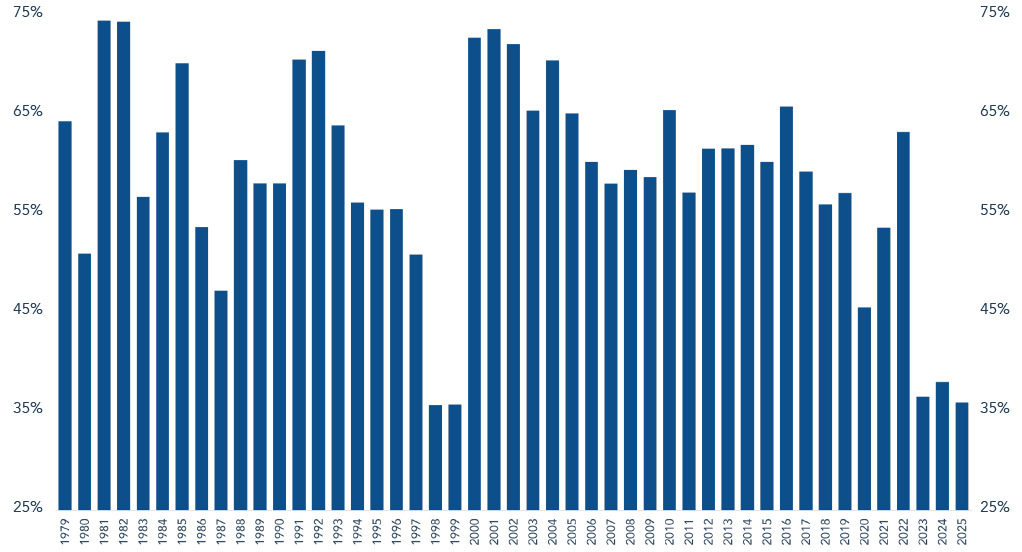
Source: Troy Asset Management and S&P Dow Jones, 31 December 2025. Past performance is not a guide to future performance.
A portfolio seeking to protect and grow capital is not simply a diluted equity portfolio. Its purpose is to combine risk-seeking assets with genuinely diversifying exposures so that no single idea, sector, style or macroeconomic outcome dominates or determines the investor’s outcome. If you were constructing a well-diversified portfolio today, you would not be as concentrated as the global stock market index.
We have been considering the importance of diversification at a time when it is out of fashion or just ignored. In an ideal world all prices in a portfolio would rise together, but sadly the world doesn’t work that way. The relationship between a security and other investments in the portfolio matters. When constructing a portfolio, we talk about ensuring that the investment boat does not point in a single direction. The aim is to build a portfolio capable of withstanding different investment outcomes. The concentrated global indices of today may not prove so resilient, should circumstances change. Chasing investment fashion or momentum is a game we choose not to play for reasons of prudence.
Balance is important. We should resist both over-concentration and over-diversification (or “Diworsification”as Robin used to call it), which lead to incoherence in a portfolio. Investment style can help with security selection, but growth investing without valuation discipline becomes speculation, while an overly rigid valuation discipline may miss great compounders of capital. A manager who exclusively favours equities without any liquidity risks becoming a forced seller at the worst possible time. We believe the merits of diversification are very undervalued, and underappreciated, in today’s markets. That will not last forever. It is important to remember: it will be the equity index that leads the earnings decline, not the other way round. There will be no notice for investors, when the market cycle eventually turns.
The price is not always right
Some of the best equity investment opportunities lie in good businesses that have suffered from long de-ratings of their valuations. Investors simply re-appraise the value of the earnings. This can happen suddenly if the profit outlook changes, as profit warnings are rarely greeted with enthusiasm. But what of companies with stable and consistent returns where earnings are reliable and growing over time? The best example of a de-rating was the peak valuations of the Nifty 50 stocks in the early 1970s. These so-called ‘one decision’ stocks de-rated from extreme valuations in an era of inflation and rising interest rates. Market darlings, like McDonald’s and Walt Disney, fell from ~80x earnings to mid-teens valuation multiples over two years, which led to share price falls of over 70%. Over the same period, Coca-Cola shares halved as its earnings multiple fell from 46x to 15x, despite good earnings growth. While valuations can always go higher, they are likely to, ultimately, revert to the mean. Some of our best ideas, such as buying Microsoft in 2010 or Coca-Cola itself in 2009, came after long periods of de-rating. Microsoft’s valuation had fallen from 75x in 2000 to 10x by 2010 despite strong earnings growth and a balance sheet to envy. Similarly, Coke had fallen from 45x, reached in 1998, to 16x by 2009. These valuation changes over many years can be gradual and imperceptible shifts.
We think we are still amidst one of these periods. Elevated index valuations and narrow market leadership are only part of the story in equity markets. Beneath the surface, there are good businesses whose valuations have adjusted materially. Just as higher bond yields have restored value to parts of fixed income, a higher discount rate has compressed the valuation multiples investors are willing to pay. In many cases, this has happened despite continued earnings growth rather than the underlying economics of the business deteriorating. We have found the past year increasingly productive for new equity ideas and have added several new holdings to the portfolio that we believe offer good value and useful diversification. This explains why our equity exposure is at ~40%, close to our long-term average, despite high stock market valuations. We will continue to look for similar opportunities.
[1] This is discussed further in Troy’s Responsible Investment Report No. 22.
The information shown relates to a mandate which is representative of, and has been managed in accordance with, Troy Asset Management Limited’s Multiasset Strategy. This information is not intended as an invitation or an inducement to invest in the shares of the relevant fund. Performance data provided is either calculated as net or gross of fees as specified in the relevant figure. Fees will have the effect of reducing performance. Past performance is not a guide to future performance. This report may also contain forward-looking statements that are based on current expectations, estimates, forecasts, and projections. These statements are not guarantees of future performance and involve certain risks and uncertainties which are difficult to predict. All references to benchmarks are for comparative purposes only. Overseas investments may be affected by movements in currency exchange rates. The value of an investment and any income from it may fall as well as rise and investors may get back less than they invested. Neither the views nor the information contained within this document constitute investment advice or an offer to invest or to provide discretionary investment management services and should not be used as the basis of any investment decision. There is no guarantee that the strategy will achieve its objective. The investment policy and process may not be suitable for all investors. If you are in any doubt about whether investment policy and process is suitable for you, please contact a professional adviser. References to specific securities are included for the purposes of illustration only and should not be construed as a recommendation to buy or sell these securities.
Although Troy Asset Management Limited considers the information included in this document to be reliable, no warranty is given as to its accuracy or completeness. The opinions expressed are expressed at the date of this document and, whilst the opinions stated are honestly held, they are not guarantees and should not be relied upon and may be subject to change without notice. Third party data is provided without warranty or liability and may belong to a third party.
All references to FTSE indices or data used in this presentation is © FTSE International Limited (“FTSE”) 2026. ‘FTSE ®’ is a trade mark of the London Stock Exchange Group companies and is used by FTSE under licence.
Issued by Troy Asset Management Limited, 33 Davies Street, London W1K 4BP (registered in England & Wales No. 3930846). Registered office: 33 Davies Street, London W1K 4BP. Authorised and regulated by the Financial Conduct Authority (FRN: 195764) and registered with the U.S. Securities and Exchange Commission (“SEC”) as an Investment Adviser (CRD: 319174). Registration with the SEC does not imply a certain level of skill or training. Any fund described in this document is neither available nor offered in the USA or to U.S. Persons.
© Troy Asset Management Limited 2026.