




A Perfect Storm
“I firmly believe this collision of natural and man-made events represents one of the most serious threats to global food security in living memory – with likely devastating consequences reverberating across harvest cycles for between three to five years.”
– Professor Chris Elliot, Founder of the Institute for Global Food Security at Queen’s University Belfast
For most of human history, food security was among society’s greatest concerns. The fortunes of civilisations rose and fell with the quality of their harvests and droughts altered the course of empires. Today’s food system is one of humanity’s great technological achievements. Thanks to improved seeds, synthetic fertilisers, irrigation and modern farming techniques, food production has outpaced population growth for more than two centuries.
This has made food security easy to take for granted. However, a handful of crops, growing regions, trade routes and agricultural inputs underpin much of the world’s food supply, and increasingly face mounting pressure from climate change, water scarcity, soil degradation and geopolitical disruption. This quarter, we examined these risks alongside a developing Super El Niño to better understand how food system shocks can sustain inflation, reshape supply chains and affect the resilience of the companies in which we invest.
A Conversation on Food Security
To better understand these risks, our Investment Team met with Professor Chris Elliott, founder of the Institute for Global Food Security at Queen’s University Belfast. The picture he painted was stark. A retreat from globalisation, heightened conflict and growing environmental risks are all placing strain on the global food system. Together they create a system that is increasingly vulnerable to disruption and less able to absorb shocks.
His comments resonated with much of the thematic work our Investment Team has undertaken in recent years. Research into climate change, water scarcity, deforestation and biodiversity have repeatedly highlighted the dependence of many consumer staples companies on healthy agricultural systems. Businesses such as Nestlé, Unilever and Heineken rely on complex global supply chains and a steady supply of agricultural commodities.
We recently extended our thematic work with dedicated research on food security and regenerative agriculture. While many of the pressures facing the food system are structural and decades in the making, our research has highlighted some near-term risks that are likely to amplify these vulnerabilities; the continued disruption to trade routes through the Strait of Hormuz, and the emergence of a potentially record-breaking El Niño weather event.
Geographic Dependence
Food production relies on many essential inputs that are concentrated in surprisingly few places. Grain markets provide an example with wheat, maize and soybeans underpinning much of the world’s food system, either directly through human consumption or indirectly through animal feed. Russia and Ukraine together supply more than a quarter of the world’s traded wheat, shipped through the Black Sea. Since July, attacks on ports and vessels in the region have sharply reduced exports from both countries, with Ukraine’s grain trade association cutting its forecast for agricultural exports this season by more than half.
Fertiliser is a further example. The Strait of Hormuz is usually discussed in the context of oil, but it is also a critical artery for the global fertiliser trade. According to the Food and Agriculture Organization of the United Nations, around 30% of globally traded fertiliser products, approximately 16 million tonnes a year, normally pass through the Strait. The ongoing disruption therefore has implications well beyond energy prices. Higher fertiliser costs squeeze farm profitability and can lead to lower fertiliser application. This leaves crops less able to recover in a difficult season, a vulnerability that a Super El Niño is likely to expose.
A Perfect Storm?
El Niño is a natural climate pattern that occurs when unusually warm water in the Pacific Ocean alters rainfall and temperature patterns around the world. Last month, the US National Oceanic and Atmospheric Administration estimated there is a greater than 90% chance of a very strong event this winter and a 75% chance that it becomes the strongest since records began in 1950.
El Niño-generated wind shear has already contributed to an unprecedented absence of Atlantic hurricanes, while the Pacific has experienced one of its most active typhoon seasons on record. Over the next year, changing rainfall patterns are expected to affect everything from agricultural production to shipping and mining activity. Regions that are normally wet may become unusually dry, while areas accustomed to stable growing conditions may face flooding risk and crop damage.
Historically, El Niño has reduced global yields of rice and wheat by around 1-1.5%, while maize and palm oil yields have also declined. Because food demand is inelastic, small supply deficits can trigger large price shocks. Several commodities linked to the companies we own might find themselves exposed. Cocoa production remains heavily concentrated in West Africa, with Côte d’Ivoire and Ghana accounting for more than half of global supply. Over 80% of palm oil production is concentrated in Indonesia and Malaysia. Coffee, rice and sugar production are similarly exposed to regions that have experienced significant disruption during previous El Niño events. For companies such as Nestlé, Unilever and, to a lesser extent, Heineken and Diageo, the most immediate effect is often higher commodity prices which drive up input costs.
There are also second-order consequences on consumers; in many emerging markets, food accounts for a significantly larger share of household expenditure. When food prices rise, consumers have less disposable income available for discretionary purchases, creating a further demand challenge for consumer goods companies dependent on volume growth in emerging markets. We are mindful of these risks and continue to evaluate how our holdings might perform if food-system pressures become more pronounced in 2027. Rather than attempting to forecast individual weather events or commodity prices, we focus on the resilience of the businesses we own.
We have spent the last few years speaking with our portfolio companies to better understand their sourcing practices. These have included past discussions with Nestlé’s Heads of Cocoa, Dairy and Coffee Sourcing, Unilever and Diageo’s Sustainability Leadership and Heineken’s Global Water Sustainability Manager. These conversations have provided a useful window into how global consumer businesses are adapting to a changing agricultural landscape. More recently, we have begun raising the prospect of a Super El Niño directly with executive teams. Our discussions have focused on how companies are preparing for a scenario in which agricultural costs rise further at a time when consumers have already absorbed several years of inflation. Cumulative CPI inflation over the past five years has been ~27% in the UK and ~24% in the US, reflecting a prolonged period well above central banks’ ~2% targets.[1]
FIGURE 1: CONSUMER PRICE INDEX AND FOOD CONSUMER PRICE INDEX FROM 2015 TO 2025, USING 2015 AS A REFERENCE YEAR
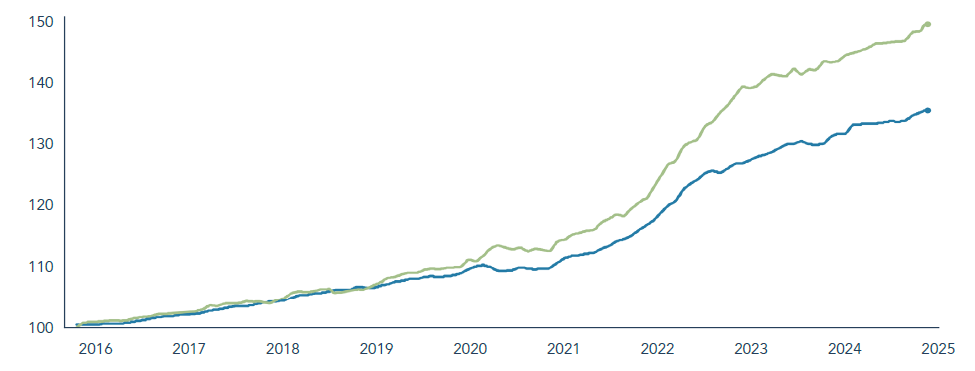
Source: UN SOFI Report 2025, Past performance is not a guide to future performance. Performance was rebased to 100 from 31 December 2014.
Regenerative Agriculture
“The nation that destroys its soil destroys itself.”
– Franklin D. Roosevelt, 32nd President of the United States
A response we hear is the growing focus on regenerative agriculture. At its core, regenerative agriculture seeks to improve the health and productivity of farmland over time. Common practices include rotating crops to improve soil fertility, planting cover crops to reduce erosion, integrating livestock into farming systems and reducing ploughing to preserve soil structure.
While often framed as a sustainability initiative, regenerative agriculture is increasingly being viewed as a supply-chain resilience strategy. Healthier soils can retain more water during droughts, reduce dependence on fertilisers and support more stable yields through periods of environmental stress. This helps explain the growing level of investment across the sector. Nestlé has committed more than CHF1 billion towards regenerative agriculture programmes and aims for 50% of key ingredients to be sourced through regenerative practices by 2030. Unilever is targeting one million hectares of farmland under regenerative management, supported by dedicated climate and nature funding, while Heineken is working with farmers through programmes designed to increase the production of regenerative barley. These investments are unlikely to eliminate supply shocks altogether, but they should help strengthen the resilience of the agricultural systems on which these businesses ultimately depend.
Building Resilience
The implications of food security extend beyond agriculture. This issue has the potential to influence inflation, consumer spending and economic growth, making it increasingly relevant for investors. The UK produces less than two-thirds of the food it consumes, leaving it exposed to global agricultural markets. The US is more insulated given a higher proportion of domestic food production, but it cannot escape the effects of a poor harvest, disrupted trade routes or higher diesel and fertiliser prices. This is one of many reasons Troy’s Multi-Asset team continues to believe that inflation may prove more persistent than central banks hope. While we cannot predict individual inflationary shocks, the Strategy remains positioned with resilience in mind through exposure to inflation-linked bonds (31%) and gold (9%). We added modestly to the duration of the Strategy’s index-linked bond exposure towards the end of September, taking it to c.3.5 years. There remains scant premium for inflation protection and with inflation expected to stay below 2.5% over the next few years. We were able to buy a 7-year index-linked bond (our longest dated security) on a real yield of nearly 3%.
While our understanding of food security continues to deepen, we are increasingly convinced that the resilience of the global food system will play an important role in shaping future inflation, investment risk and opportunity. This is why we continue to raise the issue with companies, develop our research and explore how these themes may affect our investments in the years to come.
This document has been provided for information purposes only. Although Troy Asset Management Limited considers the information included in this document to be reliable, no warranty is given as to its accuracy or completeness. The opinions expressed are as at the date of this document and, whilst honestly held, are not guarantees, should not be relied upon and may be subject to change without notice. Third-party data is provided without warranty or liability and may belong to a third party. Ratings from independent rating agencies should not be taken as a recommendation
.
References to specific securities are included for the purposes of illustration only and should not be construed as a recommendation to buy or sell these securities. Neither the views nor the information contained within this document constitute investment advice or an offer to invest or to provide discretionary investment management services and should not be used as the basis of any investment decision. The value of an investment and any income from it may fall as well as rise and investors may get back less than they invested.
Issued by Troy Asset Management Limited (registered in England and Wales No. 3930846). Registered office: 33 Davies Street, London W1K 4BP. Authorised and regulated by the Financial Conduct Authority (FRN: 195764) and registered with the U.S. Securities and Exchange Commission (“SEC”) as an Investment Adviser (CRD: 319174). Registration with the SEC does not imply a certain level of skill or training.
© Troy Asset Management Limited 2026.
[1] Source: Bloomberg.