




To judge the persistency of a company’s results out into the future it is necessary to consider subjective factors in addition to the purely quantitative. Within this, it is critical to understand the people behind a company’s results: their organisation, their processes and what motivates them. So too within our own business, we recognise the vital role of our people and the way we behave. This paper highlights Troy’s organisation and culture and why we believe it supports our goal of preserving and growing our investors’ capital over the long term.
An unusual structure
“We shape our buildings; thereafter they shape us.”
Winston Churchill
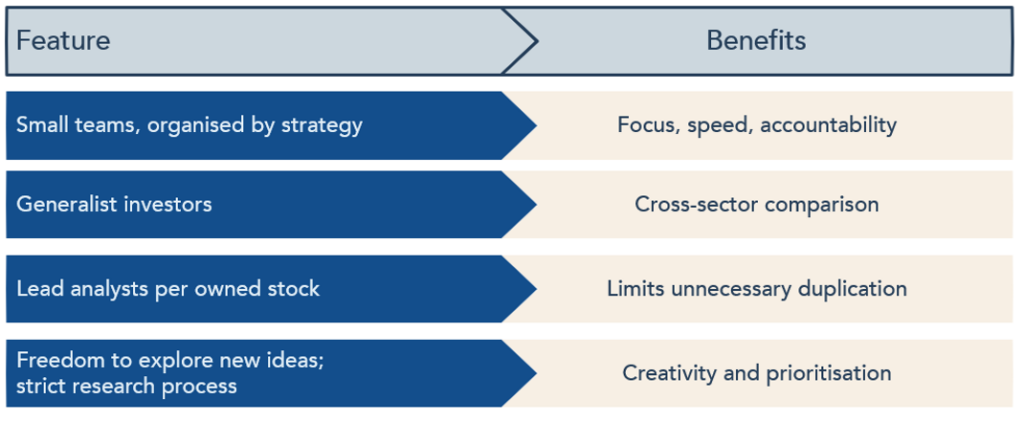
The structure of Troy’s Investment Team is unusual by industry standards. That is because whilst we have four small teams associated with each of our strategies (Multi-Asset, UK Equity Income, Global Equity, Global Equity Income), we also come together to form one larger Investment Team. We believe this structure provides the best of both worlds. Small teams associated with a particular strategy ensure accountability and allow for quick decision making. There is firmly no unwieldy management by committee at Troy. At the same time, each team benefits from the scale and perspectives of our combined experience.
Operating in this way is important because it helps us grow our collective knowledge, improves our pattern recognition, and minimises individual biases and mistakes. We believe that the sum of the investment team’s knowledge is greater than its individual parts. We do not want the team to be reliant on the expertise of specific individuals but to instead be able to rigorously and effectively debate the merits of an investment based on a shared understanding. This would be difficult to achieve if we were constantly recycling investments in and out of our portfolios or had divergent investment principles. It is manageable because we agree on the core tenets of our investment approach and are patient, long-term investors. A deep and broadly distributed knowledge of companies such as Microsoft, Diageo and Experian across the team is only possible because we have owned each company for over a decade across multiple Troy strategies.
The sum of the investment team’s knowledge is greater than its individual parts.
Collaboration and breadth of contribution is encouraged by the fact that everyone at Troy is a generalist – we purposefully do not demarcate investment responsibilities along industry or sector lines. One of the dangers of specialism is that it is easy to become too narrow and miss the wood for the trees. If you spend your working life focusing on a particular industry, you may be effective at selecting between companies in that industry but miss their wider context or fail to appreciate better options elsewhere. We are highly selective and want everyone on the investment team to think like a fund manager by comparing the potential of any company we analyse against those already held in our portfolios. Doing so helps us create competition for capital within portfolios that should ultimately lead to better results.
To successfully compare the merits of different companies across different industries requires time and effort. We actively share information and give members of the Investment Team the freedom to explore new ideas and work on a broad range of companies. It is through broadening investment horizons that we truly understand what we believe constitutes a high-quality company and a good investment. There is also a richness to such variety that means our work is never dull. We all do our best work when we are interested and engaged. Maintaining intellectual curiosity is crucial to successful investing.
We are deliberate in giving younger analysts responsibility early on in their careers and allow all members of the investment team to build expertise through the exploration of new ideas. At the same time, we come together to provide support, guidance and feedback.
Each strategy discusses and prioritises new ideas for further work. An Initiation Note is written on the most interesting ideas, acting as the basis for further discussion and debate. Once a company joins a Strategy’s investment universe, it is then up to the relevant Fund Managers to decide whether or not to invest. As patient and long-term focused investors, we are never in a rush to initiate a new holding simply because we have done the work. Instead, we recognise the importance of waiting for the right opportunity to emerge.
Constant improvement
“Great things are done by a series of small things brought together.”
Vincent van Gogh
The tightest bond holding Troy’s Investment Team together is a shared investment approach. All four strategies are slightly different in their focus but share the same investment principles. We all strive to preserve and grow our investors’ hard-earned capital and believe that the best way to compound wealth over time is to be prudent, patient and far-sighted. We aim to dial down the cacophony of noise that is ever present in markets. Our portfolios are concentrated, focused on higher-quality companies, whilst maintaining a sensitivity to valuation. As a result, we speak a common language when discussing what constitutes a good company and a good investment.
Every member of the investment team is encouraged and expected to ask questions and speak their mind.
At the same time, we cannot become stuck in our ways. An investment team that is too hierarchical stifles discussion and debate by making people afraid to voice their true opinions, often to the detriment of investment performance. We intentionally promote a flat organisational structure where every member of the investment team is encouraged and expected to ask questions and speak their mind. This is as true for an intern as it is for Sebastian Lyon, Troy’s Founder. It is also why the Investment Team is relatively small. A large team can lead to its members competing to be heard, creating more noise but not necessarily better insights. Indeed, the greater the number of opinions, the more likely one is to replicate broad market consensus.
It is easy to overlook the human element of investing. It is important to create an environment of mutual respect where ideas can be robustly challenged without being mistaken for personal criticism. Ego and office politics get in the way of trying to adjust to dynamically changing investment markets. We aim for a collegiate and collaborative culture that seeks to be objective in managing challenges. Setbacks and mistakes are an inevitable part of investing and, paradoxically, a fear of making any errors can inhibit the creative thinking required to generate good long-term returns. It is important to us that mistakes are owned collectively by the team and seen as something to learn from.
We review our decision making in a systematic rather than ad hoc way. If investment decisions and mistakes are regularly reviewed as part of a process, they are less likely to evoke strong emotions. We hold regular research lunches throughout the year, which present opportunities to formally review how our investment process can be improved and inspire a variety of adjustments – for instance, changes to our AGM voting process, the structure of our research notes, or new processes for reviewing underperforming holdings. Many of the changes are incremental in nature and often mundane in isolation. Cumulatively they are very important because they acknowledge that investing is highly competitive, and we simply can’t rest on our laurels.
Diversity of thought
“Group wisdom emerges whenever information is dispersed among different minds.”
Matthew Syed
Maintaining a diverse team, with a plurality of ideas, is one important way we seek to adapt to inevitable change. We have been deliberate in building a team of different ages, backgrounds, and experiences and the team is now more diverse than it has ever been. In terms of age, there is an even balance between those in their twenties, thirties, forties, and fifties. From a cognitive perspective, we have sought to complement the predominantly Anglo-Saxon humanities backgrounds of existing members of the team with individuals with different interests and experiences. Tomasz Boniek has Polish parents, grew up in Italy and holds a Master’s in Economics from Bocconi University and an MBA from the London Business School. Fergus McCorkell has a doctorate in Zoology (Biomechanics) from Oxford, and Aniruddha Kulkarni grew up in India, has an Engineering degree from the University of Pune and a Master’s in Finance and Economics from Cambridge.
We have made progress in improving the gender diversity of the team and recognise there is more to be done in this area. Four of our thirteen team members are now female. Gabrielle Boyle is a Director of the business and Co-Manager Troy’s Global Equity Strategy. Charlotte Yonge is Co-Manager of Troy’s Multi-Asset Strategy and co-founded Girls Are Investors (GAIN) to inspire young women to pursue a career in the industry. Troy is a founding sponsor of the charity.
Very low staff turnover is indicative of Troy’s collaborative culture and supportive of a consistent investment strategy. However, it naturally slows the evolution of diversity. One way to overcome this is to seek a broad set of candidates for our annual internship programme. Our aim is to interview a diverse pool of candidates of different genders, races and socio-economic backgrounds and award internship places based on merit. Interns have long played an important role in keeping the team fresh by absorbing the ideas and perspectives of younger people. Occasionally they result in full-time employment at Troy. Charlotte Yonge, Fergus McCorkell and Aniruddha Kulkarni all joined the team this way.
Close alignment
“Show me the incentive and I will show you the outcome.”
Charlie Munger
Troy can only invest with patience because there is a close alignment between all stakeholders in our business. Private ownership, with equity widely owned across Troy’s employee base, bestows several advantages. By having a shareholder base that is closely aligned with our objectives as investors, Troy is not beholden to outside pressures and can steer its own course. Rather than constantly launching new funds to diversify Troy’s business, we believe that focusing our efforts and staying true to our founding principles creates better alignment with the funds’ investors and leads to superior investment results. Should we meet or exceed our investors’ expectations across the four strategies we manage, the business should look after itself. We further align ourselves with Troy’s underlying investors by investing alongside them in our own funds.
We place great store in developing deep and trusted relationships with our investors. The investment objectives of our clients must align with Troy’s patient investment approach. Troy doesn’t have a ‘sales’ or ‘marketing’ department but has a Business Development and Investor Services team instead. The distinction is a purposeful one. We don’t have sales quotas, aggressively advertise our funds on billboards or engage in behaviours that promote short-termism. We value long-lasting relationships with our investors based on a mutual appreciation of Troy’s investment philosophy. As highlighted by the regular newsletters Sebastian Lyon has written for over 20 years, we try to avoid financial jargon in order to provide our investors with insights into how we think and why we invest in the way that we do. We will not always get things right and will undoubtedly make some mistakes along the way, but we will be transparent and open when we do.
We value long-lasting relationships with our investors based on a mutual appreciation of Troy’s investment philosophy.
One of the dangers of being a privately-owned investment boutique is insularity. Troy has always aspired to the highest standards of governance and benefits from the oversight of highly experienced and astute non-executive directors. In its early days Troy had more non-executive directors than employees! For a long time, the firm had a fund of funds for managing the wealth of Troy’s founding family, giving insight into the practices of other leading managers. The legacy of this continues in Troy’s podcast, Far From The Finishing Post, which interviews other, successful fund managers. As the podcast’s name suggests, investing is a competitive endeavour that is never complete and rarely mastered. Being open to different views and opinions allows us to critically assess our own.

Troy is outward facing in other ways and has been supporting charitable causes since 2010 when we were only 12 employees. In 2013, a Charity Committee was formally established to promote wider employee engagement in decision making and membership of the Charity Committee rotates on a biennial basis. On an annual basis, each employee nominates a charity in which they or their family have a particular interest and a portion of Troy’s annual charity budget is allocated accordingly. The budget allocation is overseen by the Committee, which is responsible for identifying and meeting with worthwhile charities and sponsoring well-run, targeted initiatives where Troy’s financial support will make a material difference. Troy’s financial support for charitable causes amounted to £350,000 in 2025, and over £3.4m since 2010.
Summary
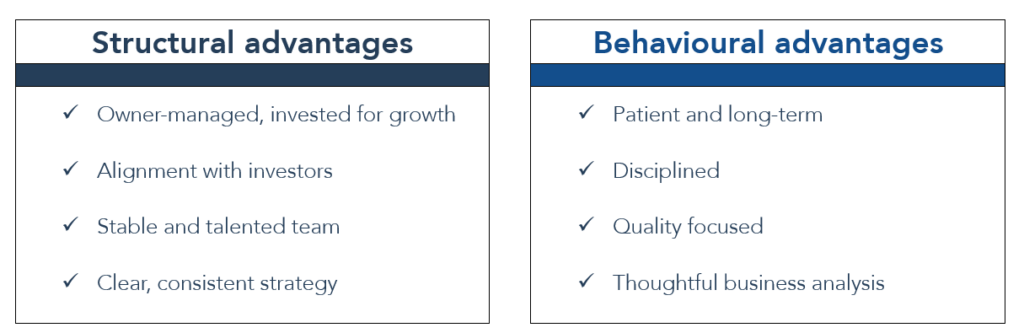
As an Investment Team, we spend a lot of time thinking about the enduring competitive advantages of the companies we own. It is as important that we focus on how we can continue to succeed as investors, building on and developing what we consider to be our own competitive edge. We believe that Troy’s competitive advantages are both structural and behavioural in nature. Being owner-managed and focused on just four highly complementary strategies aligns our interests with those of our investors. Good alignment, a clear strategy, and strong relationships with our investors allow us to remain disciplined and invest in a patient and long-term oriented way. Taking a longer-term view than the market enables us to look through short-term share price moves and focus on the fundamental drivers of a company’s success. The structure of the investment team ensures clear accountability and quick decision-making. Shared investment ideals engender a collegiate and collaborative culture, facilitating constructive challenge and debate. A good culture and broad employee ownership of the business, attracts and retains talented people. Low employee turnover helps us build our collective knowledge and invest in a consistent way.
Whilst these advantages provide a solid foundation for investment success, they don’t guarantee it. As an investment team, it is imperative that we remain on the front foot and strive to get better. This involves augmenting the cognitive diversity of the team and incrementally improving the way we operate. By doing so, we are well placed to deliver on our objective of preserving and growing our investors’ irreplaceable capital over the very long term.
This document has been provided for information purposes only. Although Troy Asset Management Limited considers the information included in this document to be reliable, no warranty is given as to its accuracy or completeness. The opinions expressed are expressed at the date of this document and, whilst the opinions stated are honestly held, they are not guarantees and should not be relied upon and may be subject to change without notice. Third party data is provided without warranty or liability and may belong to a third party. Ratings from independent rating agencies should not be taken as a recommendation.
References to specific securities are included for the purposes of illustration only and should not be construed as a recommendation to buy or sell these securities. Neither the views nor the information contained within this document constitute investment advice or an offer to invest or to provide discretionary investment management services and should not be used as the basis of any investment decision. The value of an investment and any income from it may fall as well as rise and investors may get back less than they invested. Third party data is provided without warranty or liability and may belong to a third party.
Issued by Troy Asset Management Limited (registered in England & Wales No. 3930846). Registered office: 33 Davies Street, London W1K 4BP . Authorised and regulated by the Financial Conduct Authority (FRN: 195764) and registered with the U.S. Securities and Exchange Commission (“SEC”) as an Investment Adviser (CRD: 319174). Registration with the SEC does not imply a certain level of skill or training. Any product described in this document is neither available in the USA or to U.S. Persons. © Troy Asset Management Limited 2026.